See how deposits, withdrawals, bank payments, gateways and processing claims differ, and why payment access does not make a casino service lawful in Australia.
Payment methods can look like a simple menu of ways to move money. In Australia, the legal context changes how that menu should be read: the Interactive Gambling Act 2001 makes it illegal for operators to provide real-money online casino games, including pokies, poker and table games, to people physically located in Australia. Payment access does not make such a service lawful.
That distinction matters before you compare any payment option. A bank transfer, digital wallet or voucher is a way to move funds; it does not change the legal status of the activity being paid for. Nor does a payment method’s appearance on a website establish that an Australian customer can lawfully use the service. Treat payment descriptions as information about payment infrastructure, not as an invitation or endorsement.
Specialist reviews of online casino payments describe several broad categories: bank transfers, e-wallets, prepaid cards and cryptocurrencies. These labels tell you what kind of system is involved, but they do not establish that a particular service is available, suitable or lawful for someone in Australia. The operator, the payment provider and Australian restrictions all affect what can be offered or processed.
Choosing a casino payment method means weighing the deposit options and payout details that matter to you. Use these operator notes to see which payment-related facts are available before deciding.
GoldenCrown
GoldenCrown lists a Curacao Gaming Control Board licence, OGL/2023/176/0095, held by Hollycorn N.V.
Lucky Dreams
Lucky Dreams lists a minimum deposit of A$20 when you use POLi. Its licence is listed as Curacao.
House of Pokies
House of Pokies lists PayID payouts at 1–24 hours and a minimum deposit of A$30, with PayID deposits from A$10. Its source describes the licence as an international iGaming licence but does not name the jurisdiction.
Vegaz Casino
Vegaz Casino lists a Curacao licence, OGL/2024/1335/0780, and a minimum deposit of EUR 20.
Rollero Casino
Rollero Casino lists a Curacao Gaming Control Board licence, OGL/2023/176/0095, held by Hollycorn N.V.
MrPacho
MrPacho lists crypto payouts at 30–120 minutes and fiat payouts at 24–72 hours. Its stated minimum deposit is A$30.
Ricky Casino
Ricky Casino lists crypto payouts under 1 hour and PayID payouts at 1–3 business days. The minimum deposit is A$20, or A$30 to qualify for the bonus.
DragonSlots Casino
DragonSlots Casino lists a Curacao Gaming Authority licence held by Jumpman Gaming Ltd.
Wild Tokyo
Wild Tokyo lists a minimum deposit of A$10, crypto payouts at 30–60 minutes, and fiat payouts at 1–5 days. Its licence is listed as Curacao.
Kingmaker
Kingmaker lists crypto payouts at about 90 minutes and fiat payouts at 1–5 days. Its stated minimum deposit is A$30.
Bank payments move funds through an account held with a financial institution. E-wallets hold or route funds through a separate digital account. Prepaid products are loaded with value before use, while cryptocurrency transfers use digital assets and blockchain networks. Those are category-level distinctions, not a ranking. The right comparison criterion depends on the context, and none of these categories makes real-money online casino play in Australia permissible.
The practical lesson is to separate the payment rail from the service. A method may exist in the wider payments market without being available for a particular transaction. A payment brand may also appear in a general guide while being blocked, restricted or unsupported in a specific setting. The label alone is not enough.
Visa and Mastercard are familiar examples of card networks, but familiarity does not guarantee acceptance. A specialist review reports that Australian financial institutions block many standard transactions to offshore casinos. That is a description of reported payment restrictions, not a dependable promise that a card transaction will succeed or a reason to try to bypass a block.
More broadly, a declined or unavailable payment route should not be treated as a technical obstacle to work around. Australian law prohibits operators from providing real-money online casino services to people in the country. Switching to another payment type would not alter that rule. The payment method is not a legal workaround.
This also means that terms such as “phone payment” describe a device or access point, not a separate legal category. A phone can access banking or wallet functions, but using a mobile device does not change what the underlying transaction is for. The same principle applies to names attached to newer financial apps: a familiar app or payment label does not establish local availability or make a prohibited casino service lawful.
When you encounter a payment claim, identify what it actually says: whether it names a broad category, a specific provider, or an operator’s own accepted methods. Then keep that information separate from the question of legality. A payment option can be technically described without being an appropriate route for an Australian resident.
For an Australian reader, the key filter comes first: real-money online casino games offered to people in Australia are prohibited under the Interactive Gambling Act 2001. Payment categories may help explain how online transactions are structured elsewhere, but they should not be mistaken for a lawful set of casino payment choices here. A payment menu is not permission.
A payment option shown at the point of deposit does not, by itself, establish how money could be returned. Depositing and cashing out are separate transactions, and an operator may handle them through different routes. That distinction matters before any funds are sent: a method that accepts money into an account may not be available to send money back out.
Attention: A method that accepts money into an account may not be available to send money back out.
Australian law sets an important boundary around this subject. Under the Interactive Gambling Act 2001, operators may not provide real-money online casino games, including pokies, to people physically located in Australia. The payment information below describes a general transaction distinction; it is not an invitation to use an offshore casino or a recommendation to make a payment.
A deposit is an incoming payment to an account. A withdrawal is an outgoing payment from it. Each direction can have its own accepted methods, checks and processing arrangements. A payment option displayed for deposits should therefore not be read as confirmation that the same option will handle withdrawals.
A specialist review reports that casino payment methods can differ between these two stages. That is a reason to check the terms that apply to the specific operator, rather than treating a method name or logo as a complete description of the payment arrangement. The practical question is not simply, “Can this method send money in?” It is also, “What route, if any, is available for money to leave?”
PayID illustrates why the distinction needs checking. A specialist review notes that its availability for deposits depends on the operator and that withdrawal support must be checked separately. Seeing PayID listed for one transaction does not settle the other. The detail is operator-specific; a label is not a cashout plan.
The sensible order of review is straightforward: establish what the withdrawal terms say before acting on a deposit option. Look for the permitted withdrawal route, any conditions attached to it and whether the operator requires the outgoing transaction to use a particular method. If the information is unclear, treat that uncertainty as unresolved rather than assuming the deposit route will also work in reverse.
This is basic casino payment risk management: assess the return path before the sending path. It does not mean that a particular method is better, or that any operator is appropriate for people in Australia. It means that a payment decision should account for both directions instead of judging the arrangement only by how easily money can be sent.
Keep the wording precise when reviewing payment terms. “Accepted for deposits” and “available for withdrawals” describe different permissions. “Payment methods available” may be too broad to answer either question unless the terms specify which transaction each method supports. A clear comparison records the deposit route and the withdrawal route in separate columns. If the withdrawal column is blank, the uncertainty remains. Neat table. Unhelpful blank.
Do not assume that a successful deposit confirms that an account is ready to withdraw funds. Operators may request identity documents, proof of address or evidence relating to the payment method; those checks are distinct from whether a route is listed. The relevant requirements should be understood before money is involved, not discovered only after an outgoing payment is requested.
For anyone in Australia, the legal boundary remains decisive: real-money online casino services are prohibited for operators to provide to people located here. Comparing payment mechanics does not change that rule. A deposit option is not proof of legal availability, and a withdrawal route is not a substitute for checking the law.
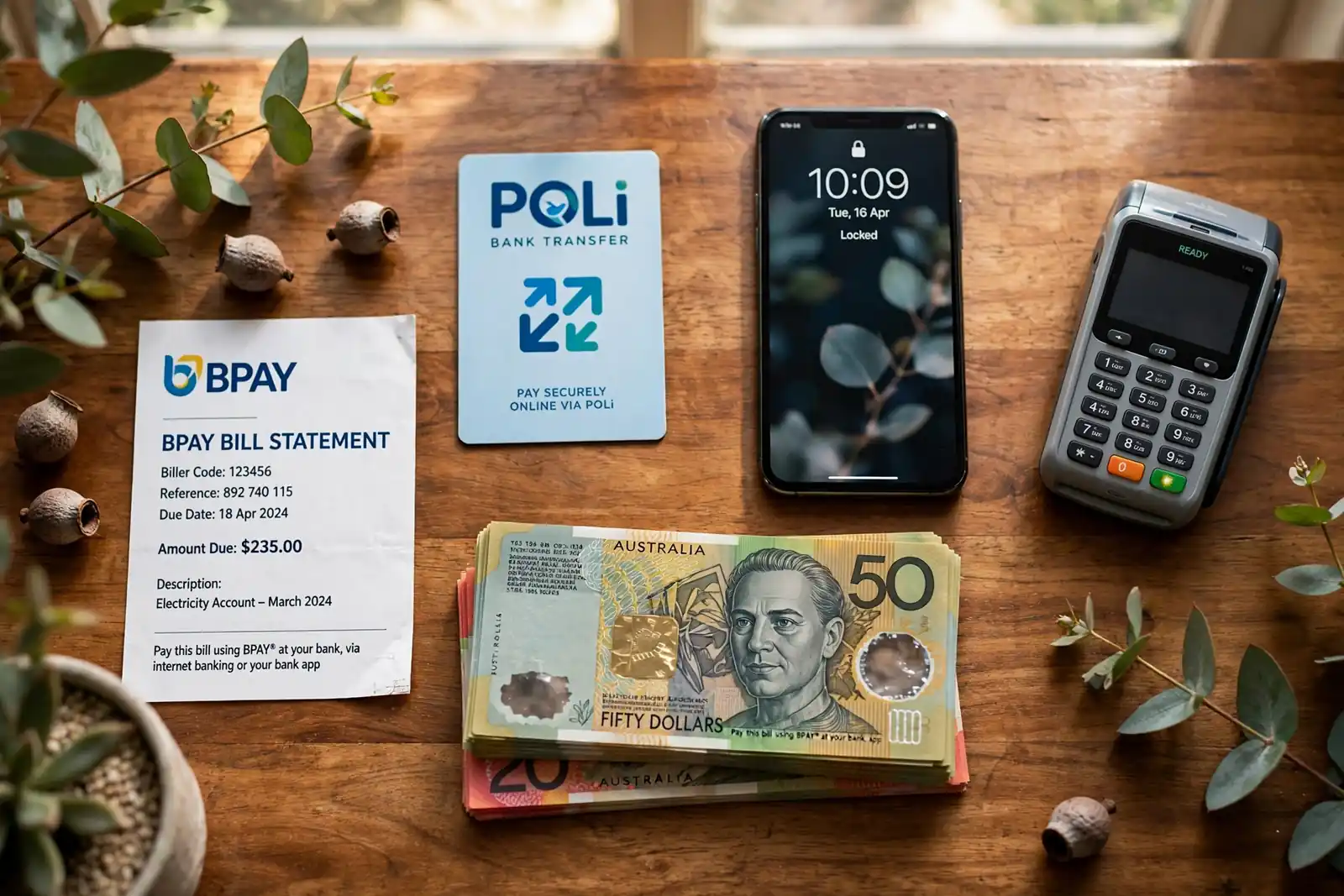
PayID and BPAY are Australian bank-payment systems, but their mechanics differ. PayID connects a memorable identifier to a bank account through the New Payments Platform. BPAY uses bill-payment details and a slower processing cycle. Those differences matter when assessing how a payment is initiated and how long it may take to appear.
PayID connects a memorable identifier to a bank account through the New Payments Platform, while BPAY uses bill-payment details and a slower processing cycle.
There is an important legal boundary: under the Interactive Gambling Act 2001, operators cannot lawfully provide real-money online casino games to people physically in Australia. The comparison below explains payment mechanics; it is not an invitation to use either method for prohibited gambling services.
A PayID can be a mobile number, email address or ABN linked to an Australian bank account through the New Payments Platform. Instead of entering conventional account details, a payer can use the linked identifier. PayID is supported by every major Australian bank.
That bank connection is the key distinction from a bill-payment system. PayID is designed to route a payment using an identifier associated with the account, rather than relying on a biller reference and a slower payment cycle. But the existence of PayID at your bank does not establish that a particular merchant or service accepts it. A specialist review describes operator availability as dependent on the operator, so acceptance should not be treated as universal or permanent.
Keep the payment route and the account link clear in your records. An identifier points to an account; it does not, by itself, confirm who will receive a payment or what rules apply to the service requesting it. Check the recipient details shown by your bank before authorising any transfer.
BPAY works through biller details and a customer reference number, rather than a PayID identifier. A specialist review gives a processing period of one to two business days for BPAY payments. That makes it a poor fit when a payment must be available for real-time use. The same review describes BPAY as rarely used for real-time gameplay and as a possible backup when PayID is unavailable.
The distinction is practical, not merely cosmetic. If you enter a BPAY payment, the reference information needs to match the instructions provided by the biller. A mistyped or mismatched reference can complicate identifying the payment. With PayID, the central check is that the identifier resolves to the intended recipient. Neither system removes the need to verify who is asking for the money.
| Feature | PayID | BPAY |
|---|---|---|
| Payment detail | Linked mobile number, email address or ABN | Biller details and customer reference |
| Bank connection | New Payments Platform | Bill-payment process |
| Timing noted by a specialist review | No timing stated here | One to two business days |
| Practical distinction | Identifier-based transfer | Slower bill-payment cycle |
The timing comparison should not be stretched into a promise: processing can depend on the service receiving the payment, and a payment method being available at a bank does not mean it is available for every transaction. For Australian bank-payment mechanics, PayID’s defining feature is its link between an identifier and an account; BPAY’s defining feature is its biller-based process and longer stated cycle. Different jobs, different clocks.
Before making any payment, confirm that the recipient and purpose are lawful and that the details match what your bank displays. A familiar Australian payment rail does not make a prohibited service lawful.
A payment method is the way money is intended to move; a gateway is part of the route a payment request takes. The distinction matters because seeing a familiar method at a payment screen does not, by itself, tell you where the transaction will go or whether that same route can handle a withdrawal.
A gateway acts as a payment junction, routing the request between the service seeking payment and the selected payment channel without changing the method's own rules.
Think of the gateway as a payment junction. When a payment is initiated, the gateway helps route the request between the service seeking payment and the payment channel selected. It is not the bank account, wallet or other method you choose, and it does not change that method’s own rules. The gateway’s role is about handling the route; the method determines the source or destination of the funds.
That distinction is easy to lose in a list of logos. A payment page might display a method, but the logo alone does not tell you whether it is available for the transaction you want to make. A specialist review notes that casino payment methods can differ between deposits and withdrawals. Treat that as a reason to check the specific transaction options rather than assuming a deposit route can also return funds.
For a deposit, identify the method shown and the route the payment will follow. For a withdrawal, check the destination separately before committing money. A gateway involved in accepting a payment should not be taken as proof that it also supports paying funds out through the same method. The practical question is not simply, “Is this method listed?” It is, “Is this route available for the direction of payment I need?”
This is also why the phrase “online casino payment gateway” can sound more decisive than it is. A gateway is not a guarantee of acceptance, a promise about processing, or a substitute for checking the transaction terms. Nor does a payment screen establish that a service is lawful in Australia. Under the Interactive Gambling Act 2001, operators cannot provide real-money online casino games, including pokies and table games, to people located in Australia. Payment technology does not alter that legal position.
When reviewing any payment page, separate three questions: which method is being offered, whether the gateway is routing a deposit or a withdrawal, and what terms apply to that particular transaction. Keep the answer for each direction clear. A method listed for adding funds does not settle how funds could be returned, and a gateway’s presence does not fill that gap.
The same distinction applies when a payment page presents several ways to pay. The gateway is not another option alongside the methods; it is part of how a selected transaction is routed. For you, the useful detail is the actual method and its permitted use, not a broad label about payment technology. Check the withdrawal route independently, and do not treat a successful deposit as evidence that a cashout path is available.
A junction, not a guarantee.
A prepaid voucher sets a clear ceiling on what its stored balance can cover: once the loaded amount is used, there is no further value available on that voucher. That makes the spending limit visible before a transaction begins. It does not, by itself, make a payment safe or change the rules that apply to the service receiving it.
Legal Prohibition
Under the Interactive Gambling Act 2001, it is illegal for operators to provide real-money online casino games to people physically located in Australia.
The important distinction is between paying in and getting money out. A voucher deposit generally cannot be sent back to the same voucher as a withdrawal. If an account shows a balance after a voucher payment, cashing it out may therefore depend on a separate method being available. The voucher’s remaining value and an account balance are not interchangeable.
That difference affects planning. Before making any payment, confirm how a withdrawal would be handled and whether the relevant method is available for that purpose. Do not assume that a way to pay can also receive funds. If there is no suitable cashout route, a voucher can leave you with money on one side of the transaction and no matching route on the other. A payment interface may make the first step look simple; the exit route matters more.
A useful comparison is the voucher balance against the amount you intend to spend. The loaded value is the cap: it cannot cover more than it holds. This can help keep a payment within a chosen amount, but it is not a substitute for setting a budget or checking the terms of the service. Nor does a capped payment prevent other conditions from applying to an account or its balance.
For Australian readers, there is a further boundary that should not be obscured by payment terminology. Under the Interactive Gambling Act 2001, it is illegal for operators to provide real-money online casino games, including pokies, to people physically located in Australia. A voucher does not alter that legal position. This information is not an invitation to use one for online casino gambling.
When reviewing any payment arrangement, separate three questions: what amount can be spent from the voucher, what happens to any unused voucher value, and what method—if any—could receive a withdrawal. Keep those answers distinct. A voucher can place a firm limit on the payment it supplies, while leaving cashout dependent on another route. That is the practical trade-off: a clear spending cap, but no matching return path to the voucher.
Treat the payment method as only one part of the terms. Check the service’s rules before committing funds, including what happens to any balance and which payment routes are permitted. If the return method is unclear, do not assume it will be resolved automatically. A neat cap. An awkward exit.
There is no single payment route that wins on every criterion. Access, the ability to receive a withdrawal, and the total cost can point in different directions. For Australians, there is also a prior issue: the Interactive Gambling Act 2001 prohibits operators from providing real-money online casino games to people in Australia. A payment method does not change that legal position, so this comparison is not a recommendation to use an offshore casino.
If you are assessing payment claims, start with access. A method appearing in a payment menu does not establish that it will work for your account or transaction. PayID availability, for instance, is operator-dependent; a specialist review reports that it may be offered for deposits, while withdrawal support needs separate confirmation. Treat that as a specific report, not a guarantee about the market. A payment portal can display options, but the practical question is whether the stated route applies to both sides of the transaction.
Next, compare cashout suitability. A route that can move money in may not provide a way to receive it back. Before relying on any payment option, establish what withdrawal route is available and whether it matches your circumstances. This is particularly important when a method is presented as convenient for adding funds: convenience at that stage says nothing about cashing out.
Then look at total cost, not just a headline fee. A specialist review reports that some casinos charge a flat fee of $5–$15 for bank transfers, while crypto withdrawals are often described as free. Those are reported terms, not universal prices, and a zero withdrawal fee does not necessarily mean a cost-free transaction. Currency conversion can also matter: converting AUD to EUR can cost 2–4%. Check which currency the account uses and whether conversion applies before comparing routes.
A useful comparison therefore has three columns: whether the method is available for the relevant transaction, whether it supports the cashout you would need, and what fees or conversion costs may apply. If one column is unclear, that option cannot be called the best on the evidence available. Keep the comparison factual; a payment brand’s presence in a portal is not proof that it is suitable or available to you.
The winner depends on the criterion. For deposit access, availability is decisive; for cashout planning, withdrawal support matters more; for cost, include both payment charges and currency conversion. Do not let a low-fee claim outweigh an unresolved withdrawal route. A neat table beats a confident slogan.
For any lawful payment service, a withdrawal’s arrival time is not necessarily the same as the time shown for processing. A request may first wait for the operator’s review, then travel through the payment provider and the receiving bank. Those stages can make a quoted transfer time a poor guide to when funds would actually arrive.
There is an important Australian limit: the Interactive Gambling Act 2001 prohibits operators from providing real-money online casino games to people in Australia. The timing and fee comparisons below describe claims reported in specialist reviews; they are not an endorsement of using an offshore casino or a promise that a route will be available.
A specialist review reports that some casino bank withdrawals are handled manually only once or twice a week. In that account, a request made on Friday could arrive by Wednesday. The gap is a reminder that the clock may not start moving when you press the withdrawal button. If staff process requests in batches, a request can sit in a queue before the bank transfer itself begins.
The same review says traditional bank-transfer cashouts may take as long as five days. Treat that as a reported maximum, not a universal service standard: the operator’s own approval process and its stated terms determine what applies to a particular account.
A specialist review describes MuchBetter withdrawals as faster than traditional bank transfers, but gives no fixed arrival time. That comparison does not establish that MuchBetter is offered by any particular operator, or that it can be used for every withdrawal.
Reported timeline of up to five days and may be delayed by manual batch processing.
Reported one-to-two-day bank transfer time with possible transaction fees of one to three per cent.
Reported as faster than traditional bank transfers, though no fixed arrival time is stated.
For Skrill, a specialist review reports that a transfer from the wallet to a bank takes one to two days. It also says some casinos charge a transaction fee of one to three per cent. The fee is not presented as a Skrill charge that applies everywhere, so check the relevant terms and whether the deduction is made by the operator or another part of the route.
Compare the full journey, not just the first processing estimate: operator review, payment-provider handling and onward transfer to your bank can each affect the result. A faster wallet stage does not remove a manual queue, and a stated fee may alter the amount ultimately received. Before any transaction, confirm the withdrawal method and its terms directly with the service provider. Do not assume that a deposit route can also receive a payout.
The practical comparison is therefore conditional: bank transfer has a reported timeline of up to five days and may be delayed by batch processing; Skrill has a reported one-to-two-day bank transfer time with possible fees; MuchBetter is reported as faster than bank transfer, without a stated duration. These are source-specific descriptions, not guarantees. Verify the current terms before relying on them.
“Instant” describes the reported time for a payment to be processed; it does not mean that a service is available to Australians or that a game can be accessed as soon as money moves. Payment speed and legal availability are separate questions.
A specialist review describes Visa and Mastercard deposits as instant. That claim should not be read as a usable card-payment option in Australia: credit cards cannot be presented for online gambling, and Australian financial institutions block many standard transactions to offshore casinos. A payment label can promise speed and still lead nowhere. Fast, but unavailable.
BPAY works to a different timetable. A specialist review puts its payment period at one to two business days, so it is rarely suited to real-time gameplay. The same kind of review describes BPAY as a possible fallback when PayID is unavailable. That makes it a slower alternative, not an instant route. If timing matters, check the stated processing period before relying on a payment option.
There is also a wider legal boundary. Under the Interactive Gambling Act 2001, operators cannot provide real-money online casino games, including pokies and table games, to people physically in Australia. A quick payment does not change that restriction or make an offshore casino service lawful to provide here.
When you see an instant-payment claim, separate three points: whether the method is described as fast, whether it can actually be used for the transaction, and whether the service itself may lawfully be offered in Australia. Those are not interchangeable. A payment could be processed promptly in a context where it is available, while an Australian bank may block the transaction; a slower option such as BPAY may be described as a fallback, but its timing still matters.
Treat promotional speed language as a narrow claim about processing, not a promise of access or gameplay. For Australians, the important distinction is not simply fast versus slow. It is whether the payment route is available and lawful in the first place.
A payment app’s presence on a phone does not establish that it can be used for gambling transactions in Australia. The legal position comes first: under the Interactive Gambling Act 2001, operators must not provide real-money online casino games to people in Australia. This includes pokies and table games. A payment logo or checkout option does not change that rule.
Operators may require official identification, proof of address from the last three months, and confirmation of payment method ownership before processing transactions.
Apple Pay illustrates why the distinction matters. A specialist review describes deposits made through a phone’s digital wallet, with biometric authentication used to approve the payment. That explains the payment experience it reports; it does not establish that the service is currently available for gambling in Australia or that it can be used to withdraw money. A wallet’s role in a transaction, where offered, is not the same as the operator’s legal status.
PayPal has taken a different position: it has prohibited gambling transactions in Australia since 2021. Treat that as an Australian restriction, not as a temporary checkout error to work around. If an app or website suggests otherwise, do not assume that the payment will be permitted or that a displayed option makes the underlying service lawful.
Names such as PayID, Paysafecard, EcoPayz, UPI and ACH also do not tell you whether a particular payment is eligible, supported or lawful. They describe different payment systems, and their appearance in a payment menu is not proof that a real-money casino service may lawfully be offered to you. An app can also handle a deposit without being a supported route for getting funds back; do not infer withdrawal support from a deposit button.
There is a further practical check: a specialist review says an operator may ask for official identification, evidence of your address dated within the previous three months, and confirmation that the payment method belongs to you. Have those details in mind before sharing financial information, and consider whether you want to provide them to the service at all.
For a mobile payment app, the useful criteria are eligibility, the data requested and whether the stated payment purpose is permitted—not how polished the checkout looks. A quick biometric approval is still a financial transaction. Read the terms carefully, and do not treat convenience as proof of safety or legality.
A phone can make a bank payment easier to authorise, but it does not change whether a gambling service may legally accept that payment. Under Australia’s Interactive Gambling Act 2001, operators cannot provide real-money online casino games, including pokies, to people located in Australia. A mobile checkout is not an exception.
PayID connects an Australian bank account to an identifier through the New Payments Platform. That identifier can be a mobile number, an email address or an ABN. From a phone, you can enter the linked detail in your banking app rather than typing out account information. The identifier points to the bank account; it is not a separate wallet or a guarantee that a payment will be accepted. PayID availability for a particular service can depend on the operator, and its support for withdrawals must be considered separately.
Apple Pay uses a different mobile experience. A specialist review describes deposits made through the phone’s digital wallet and confirmed with biometric authentication, such as a fingerprint or face scan. That describes a reported deposit route, not a general rule that every service accepts Apple Pay. Nor does it mean the wallet can receive withdrawals. A quick authorisation is only one step in a transaction.
For a casino mobile payment, the useful distinction is between the phone’s role and the payment method itself. Your phone may display bank details, open a digital wallet or confirm your identity; the underlying bank or wallet still handles the payment. Before entering any financial details, consider the legal status of the service and what the requested transaction would fund. Australian law prohibits operators from offering these real-money casino services to people in the country.
Keep the screen convenience in perspective. Face or fingerprint confirmation can reduce the steps needed to approve a wallet payment, while PayID can make a bank transfer easier to address. Neither feature makes an unlawful service lawful. A phone makes the tap simpler. Nothing more.
Yes. Bank transfers may incur a $5–$15 fee, some casinos charge 1–3% for Skrill transactions, and currency conversion from AUD to EUR can cost 2–4%; crypto withdrawals are usually free.
Real-money online casino games are prohibited for operators to provide to people in Australia, and Australian financial institutions block many standard Visa and Mastercard transactions to offshore casinos.
Visa and Mastercard deposits are instant, while BPAY payments take one to two business days.
MuchBetter withdrawals are faster than traditional bank-transfer cashouts, which can take up to five days. Real-money online casino games are prohibited for operators to provide to people in Australia.