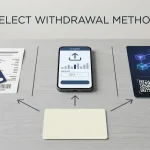
A withdrawal can involve request processing, account checks and a separate transfer through the chosen payment method.

“Instant payout” sounds like a promise about when money will reach you. In practice, it may describe only one part of a withdrawal process: how quickly a casino says it handles a request, or how a particular payment route works after the request has been approved. Those are not the same as a guarantee that you can access your winnings immediately.
To compare an instant payout casino fairly, separate the claim into stages. First, you submit a withdrawal request. The operator may then review the request and your account. Only after that can the money be sent through the selected method, with the receiving institution or service handling its own part of the transfer. A claim about speed at one stage does not establish how long the full sequence will take.
The useful question is therefore not just whether a site uses the word “instant”. Look for a clear description of what the stated speed covers. Does it refer to processing the request, or to funds arriving with you? Does the operator say whether account checks can pause a withdrawal? Are there conditions that apply to the amount you can take out? If the wording leaves these points unclear, the headline tells you little about the result.
If fast access to your winnings matters, check the stated payout methods and timeframes before choosing an online casino. This list highlights the available payout details for Australian players.
GoldenCrown
GoldenCrown lists a Curacao Gaming Control Board licence, OGL/2023/176/0095, held by Hollycorn N.V. The available details identify its licensing, but do not specify payout speed.
Lucky Dreams
Lucky Dreams lists a A$20 minimum deposit via POLi and a Curacao licence. No payout timeframe is specified in the available details.
House of Pokies
House of Pokies lists PayID payouts in 1–24 hours and a A$30 minimum deposit, with PayID deposits from A$10. Its source describes the licence as an international iGaming licence without naming the jurisdiction.
Vegaz Casino
Vegaz Casino lists a Curacao licence, OGL/2024/1335/0780, and a EUR 20 minimum deposit. The available details do not state its payout speed.
Rollero Casino
Rollero Casino lists a Curacao Gaming Control Board licence, OGL/2023/176/0095, held by Hollycorn N.V. No payout timeframe is provided in the available details.
MrPacho
MrPacho lists crypto payouts in 30–120 minutes and fiat payouts in 24–72 hours. Its stated minimum deposit is A$30.
Ricky Casino
Ricky Casino lists crypto payouts in under an hour and PayID payouts in 1–3 business days. The minimum deposit is A$20, or A$30 to qualify for the bonus.
DragonSlots Casino
DragonSlots Casino lists a Curacao Gaming Authority licence associated with Jumpman Gaming Ltd. The available details do not specify payout speed.
Wild Tokyo
Wild Tokyo lists crypto payouts in 30–60 minutes and fiat payouts in 1–5 days, with a A$10 minimum deposit. It also lists a Curacao licence.
Kingmaker
Kingmaker lists crypto payouts in approximately 90 minutes and fiat payouts in 1–5 days. Its stated minimum deposit is A$30.
A payout description is more informative when it distinguishes operator handling from the transfer itself. “Processed quickly” and “received immediately” make different claims. Even a clearly described process should not be read as an unconditional guarantee: your request may be subject to checks or restrictions, and the wording on a promotional page may not capture every condition.
For a practical comparison, record what the operator says about the request, what might hold it up, and what limits apply. Then compare those details across sites rather than treating “instant” as a rating. If one operator explains the stages and another offers only a bold speed label, the first gives you more to assess. That does not prove it will pay faster; it makes the claim easier to interpret.
This distinction matters especially when a site presents a fast payout as though the speed were a fixed property of the casino. A withdrawal is not simply a button press followed by money appearing in your account. The operator’s handling, any account review and the terms governing access all matter. A short label cannot do the work of those details.
 Online Keno Casinos in Australia: Legal PositionLearn how the Interactive Gambling Act treats real-money online keno, why foreign licences do not authorize it, and ACMA’s enforcement role.
 Most Trusted Online Casinos in Australia: Key ChecksLearn why a casino accepting Australian customers is not the same as holding a domestic licence, how the Interactive Gambling Act 2001…
A specialist casino review reports that operators may require identity checks before a first withdrawal. The requested material can include a photograph of your identity document and proof of address, and some operators may also ask for a selfie while you hold the document. The important point for your comparison is timing: if verification is required before payment, a withdrawal claim that omits this condition does not describe the whole route to your money.
Check whether the site explains what documents it asks for and when they must be supplied. Do not assume that being able to deposit, play or submit a withdrawal request means the account has already cleared every check. Having documents ready may help you respond to a request, but it cannot guarantee approval or a particular payout time.
Privacy also belongs in the assessment. Identity and address documents contain personal information, so read the operator’s explanation of how it requests and handles them before sending anything. A vague speed claim is not a reason to rush through an account check. The paperwork still matters.
Speed and access are separate measures. A specialist review reports that some casinos set weekly or monthly withdrawal caps in the $5,000–$10,000 range. If a player has a $50,000 jackpot, a cap at that level could turn access to the full balance into a multi-year payout plan. A quick first transfer would not make the remaining balance immediately available.
Attention: A withdrawal cap can turn a large jackpot into a multi-year payout plan, regardless of how "instant" the processing speed is claimed to be.
That is why a useful comparison records both the claimed processing speed and the maximum amount that can be withdrawn over the relevant period. A site may handle each permitted payment promptly while still restricting how much you can receive at once. For a large balance, the cap may matter more than the word “instant”.
Do not treat a displayed limit as a minor footnote. Read whether it applies per request or across a stated period, and whether the terms describe exceptions. The cap is part of the practical payout offer, not a separate technicality.
A concise way to judge a claim is to ask three things: what stage is described as fast, what can trigger a review before payment, and how much can be accessed under the withdrawal terms? If the site does not make those points clear, “instant” is not a dependable measure for comparing it with another casino. It is a label, not a clock.
A pokie’s return to player rate, or RTP, describes a game setting—not how quickly a casino sends money after you request a withdrawal. These are separate criteria. If you are comparing games, RTP may help you understand the game’s stated return model. If you are comparing how soon you can access winnings, the game’s RTP tells you nothing about that process.
A specialist review reports that some game providers let casinos choose between different RTP settings for the same pokie. As a result, a title you recognise may not have the same stated return percentage at every casino. The game’s name alone is not enough to establish its RTP; check the information shown for that particular version and site.
 Aussie Pokies Online in Australia: How to CompareLearn how free-play results differ from predictions and how to assess legal position, payment routes and bonus terms. Each RNG spin is…
 Best Casino in Adelaide: Booking and Visit ChecksLearn how to distinguish casino accommodation from nearby stays, compare room terms, and verify dining, parking and other practical details before a…
That distinction matters because a familiar title can create a false sense of consistency. You may recognise its layout, features and symbols, but the RTP setting can still differ. Treat the displayed rate as a property of the version being offered, not as a universal figure attached to the title everywhere.
RTP is a theoretical measure of how much a game is designed to return across play over time. It is not a forecast for your session, a promise about your balance, or a measure of how often a particular feature will appear. A stated rate can help you compare versions of the same game, provided you are looking at the rate that applies to the version you can actually play.
The criterion is specific: RTP helps compare theoretical game returns. It does not establish that one player will win, or that a particular run of spins will follow the long-term model. A higher stated rate is not a guarantee of a better result in your next session. Individual outcomes remain uncertain.
Nor is RTP a measure of the time between a win and access to its value. A game can have a stated return rate without that saying anything about the casino’s handling of a cash-out. Calling a pokie an “instant payout” game blurs two different things: the way the game produces results and the way an operator handles funds. The first is game mechanics; the second is not described by RTP.
Return to Player (RTP) is a theoretical game setting and provides no information regarding the speed or reliability of a casino's withdrawal process.
A pokie uses a Random Number Generator, or RNG, to determine outcomes. Each spin is generated as a separate random event. The result of an earlier spin does not make a later one “due,” and a recent win does not mean the next spin is more likely to lose. A sequence that looks patterned to a player does not change the independence of the spins.
This is why short sessions can look very different from a game’s theoretical return. A player may receive a run of wins, a run of losses, or a mixture that does not resemble the stated RTP. That variation is not evidence that the next outcome can be predicted from the last one. The rate describes a broader mathematical model; it does not schedule results for an individual.
The same reasoning applies when you compare instant-payout pokies. The “instant” label does not alter the RNG or make wins more frequent. It should not be read as a claim about game odds, either. Keep the terms separate: RTP concerns the game’s theoretical return, while RNG-based outcomes determine what happens on each spin.
If your priority is game return, compare the stated RTP for the specific version available to you. If your priority is a particular style of play, compare the game’s features and how they fit your preferences. Neither criterion tells you whether a withdrawal will be processed quickly. A neat comparison table needs separate columns for separate questions; combining them only makes a weak measure look useful.
For a practical check, confirm that the RTP information refers to the exact pokie version being offered, rather than relying on a rate remembered from another site. Then treat that number as an informational measure, not a personal outcome forecast. Even a clearly stated rate cannot tell you what your next spin will produce.
The useful distinction is plain: game return is not payout speed. Keep them apart.
A payout label tells you little about what happens after you submit a withdrawal request. The useful comparison is the operator’s written process: what must be completed before a request is considered, what can hold it up, and whether the terms allow the operator to restrict access to a balance. Read those conditions before depositing, not when a cash-out is already pending.
Start with the section covering withdrawals, then check the account and verification rules it refers to. Look for the point at which identity checks are required. Specialist casino reviews report that many operators request verification before a first withdrawal. Documents may include a photo of your identity document and proof of address; some operators may also request a selfie holding the document. The exact requirements can differ, so check the operator’s own current terms and make sure you understand what it expects before you play.
Also check whether the operator can pause a withdrawal while documents are reviewed, and how it communicates if a submission is incomplete or rejected. These are practical questions, not evidence that a payout will be made promptly. A process may be clearly described yet still leave you waiting for the operator to act. “Instant” is not a substitute for knowing what has to happen first.
Read for withdrawal limits as well as identity checks. Specialist casino reviews report that some operators set weekly or monthly cash-out caps. A cap can mean that a large balance is released in instalments rather than as one payment, extending the time needed to access it. Check whether the terms describe limits per request, over a period, or both, and whether they explain how an amount above a limit is handled.
Then look for conditions that could change the amount available to withdraw or make a request ineligible. The terms should explain the operator’s stated rules in plain, specific language. If a key condition is unclear, contradictory, or difficult to locate, do not assume the more favourable interpretation will apply. A vague rule is still a rule the operator may rely on.
Pay attention to whether the withdrawal process is described consistently across the relevant pages. A brief promotional claim may not match the detailed terms for account verification or cash-outs. The detailed rules matter more when they explain what the operator can require or restrict. Keep a copy of the terms you relied on and any relevant account messages; that gives you a record of what was stated, though it cannot guarantee the outcome of a dispute.
A useful comparison table can be simple:
| Check | What to establish |
|---|---|
| Verification | Which identity and address documents may be required, and when |
| Review of documents | What happens if a submission is incomplete or needs correction |
| Cash-out limits | Whether caps apply per request or across a period |
| Operator discretion | Which stated conditions can delay, restrict or prevent a withdrawal |
This is more informative than comparing claims about speed alone. A site may describe a quick internal process, but that does not establish that you will receive funds immediately or that every request will be approved. The operator’s terms tell you what it says it may do; they do not remove the risk that it may fail to pay.
That risk matters especially for Australian players using offshore casinos. If an offshore operator refuses to pay winnings, Australian players have no legal recourse in Australia. A polished withdrawal page, a detailed document checklist or a record of your communications does not change that position. Treat the terms as a way to identify uncertainty before you commit money, not as protection that makes an offshore claim enforceable locally.
If the withdrawal rules do not clearly explain verification, limits and the operator’s discretion, there is no reliable basis for calling its payout process straightforward. Set that uncertainty beside the possible loss of local recourse. The better choice depends on what you value, but clarity in the terms is a more useful criterion than an “instant” label. No wording can make a refusal harmless.
Legal Recourse
If an offshore operator refuses to pay winnings, Australian players have no legal recourse in Australia to compel payment.
The key distinction is who the law addresses. Under the Interactive Gambling Act 2001, it is illegal for a company to provide real-money online casino games, including pokies, to people in Australia without a domestic licence. No Australian licences for online casinos have been issued. In practical terms, there is no Australian-licensed online casino for you to use.
That rule is directed at operators, not individual players. An Australian is not made criminally liable simply for playing on an offshore site that accepts them. But this distinction should not be mistaken for approval, local regulation or protection. The service is still being offered from outside the Australian licensing system, and the site’s willingness to accept a player does not make its offer lawful in Australia.
A search for an online casino offering real-money play and quick withdrawals may bring up offshore operators. Their availability does not establish that they hold an Australian licence: there is no such licence to hold. Nor does a foreign licence, if an operator claims one, provide the same position as a domestic authorisation. The Australian rule concerns the operator’s provision of the service to people in Australia.
The practical risk is not mainly that you will be prosecuted for placing a bet. It is that you are dealing with a service outside the Australian licensing framework, without the protections and remedies that a local authorisation would imply. If an offshore casino refuses to pay winnings, Australian players have no legal recourse in Australia to compel payment. That matters more than the label attached to a withdrawal method.
A real-money instant payout casino can therefore make a claim about its own payment process, but the claim does not change the legal position or create a local route for resolving a dispute. A stated payout policy is not an Australian guarantee. If the operator does not honour it, the fact that a player was not the target of the law does not supply a remedy.
Australian authorities can take action against illegal offshore gambling services, including blocking access to sites. Access may therefore be disrupted, and a site appearing online at one moment is not evidence that it is locally regulated or will remain reachable. Do not treat a working website, an account invitation or an advertised payment option as proof of legal status.
For your decision, separate three questions: whether the operator is permitted to offer the service in Australia, whether you personally face liability for playing, and what recourse you would have if a dispute arose. The answers are not interchangeable. The operator faces the restriction; the individual player is not the law’s target; yet an Australian player may have no local legal avenue if an offshore operator withholds winnings.
That is the central trade-off behind offshore real-money play. A site may accept Australian customers, but acceptance is not the same as Australian oversight. If local recourse is your deciding criterion, an offshore casino cannot meet it. The distinction is plain.
A casino advertising bitcoin withdrawals may sound like a match for an instant payout. But the payment method alone cannot establish how quickly a withdrawal will be approved, whether the casino will send it, or when you will be able to use the funds. A claim about bitcoin is still a claim made by the operator.
Separate the stages. A casino may describe a withdrawal as processed, but that does not necessarily mean bitcoin has reached a wallet you control. Even evidence that a transaction has been sent cannot prove that the casino will approve a withdrawal in the first place. The word “instant” blurs those distinctions. Not the same thing.
When assessing a bitcoin payout claim, look for what it actually describes. Does it refer to the casino’s internal decision, the sending of a transaction, or funds becoming available to you? If the wording leaves that unclear, the claim gives you little basis for comparing one offer with another. Treat an unsupported speed promise as marketing, not as a dependable measure of access to winnings.
A transaction record may help establish that a particular transfer occurred. It cannot, by itself, show that every withdrawal request will be accepted or that a casino will resolve a dispute in your favour. Nor does using bitcoin provide evidence that the operator is fair or accountable. The payment route and the operator’s willingness to pay are separate questions.
That distinction matters especially for Australians considering an offshore casino. If the operator withholds winnings, Australian players have no legal recourse in Australia to compel payment. A bitcoin transaction does not change that position. If funds are never sent, there is no completed transfer to point to; if a transfer is recorded, that only relates to that transaction, not to the operator’s broader conduct.
Before treating a bitcoin offer as attractive, ask what criterion matters most to you. If it is visibility of a transfer, a transaction record may be relevant after one has been made. If it is certainty that a withdrawal will be approved and paid, the payment method cannot supply that certainty. If it is a remedy when a dispute arises, bitcoin does not create a local route to recover withheld winnings.
The practical comparison is therefore not “bitcoin versus instant.” It is a specific, verifiable statement versus a promise that leaves the important steps undefined. Do not infer a guaranteed payout from a bitcoin logo, a headline, or a reference to speed. Where the operator controls whether winnings are released, the advertised method cannot settle the central question: whether you will receive them at all.
A bonus described as “no deposit” removes the deposit condition, not necessarily the conditions attached to withdrawing winnings. If you are comparing no-deposit offers, check what must happen before bonus-related funds become eligible for withdrawal. A headline promising an instant payout cannot override a wagering requirement or a cash-out cap.
Bonus Wagering Calculation
Identify the Base
Determine if the multiplier applies only to the bonus (e.g., $500) or to the deposit plus bonus (e.g., $1,000).
Apply the Multiplier
Multiply the base by the wagering requirement (e.g., $500 bonus × 40x = $20,000 turnover).
Verify the Result
Compare the required turnover against your expected play to see if the balance is realistically convertible to withdrawable funds.
The key figure is the wagering requirement: the amount you must stake, often expressed as a multiple of the bonus or of the bonus plus your deposit. A specialist review recommends looking for a requirement of 35x or less and describes anything above 40x as punishing. Treat that as a reviewer’s assessment, not a universal rule. The practical test is the turnover the terms require and whether you would accept it before claiming the offer.
For illustration, a specialist review calculates that a $500 bonus with a 40x requirement calls for $20,000 in wagering turnover before the winnings can be withdrawn. If the requirement applies to a $500 deposit plus a $500 bonus at 35x, the required turnover is $35,000. Those calculations show why the base matters: the same multiplier can lead to a different wagering target depending on what the operator includes.
Read the wording closely. Does the multiplier apply to the bonus alone, or to the deposit and bonus together? Which games count, and do the terms set a deadline or other restrictions? The answers determine how much qualifying play is required. A large bonus can look generous while carrying conditions that make its balance difficult to convert into withdrawable funds.
Free spins can have a separate condition: a cap on how much of the resulting winnings may be cashed out. A specialist review reports that some free-spin offers include such caps. That means completing any stated wagering requirement may not make the full balance withdrawable; the cap can still limit the amount available to cash out. Check the maximum and how the terms apply before accepting the spins.
A useful comparison is therefore not simply “bonus offered” versus “no bonus.” Record the wagering base, multiplier, eligible games, any stated deadline and any cap on free-spin winnings. If a term is unclear, ask the operator to explain it in writing before opting in. Keep a copy of the offer and its terms, since promotional wording can differ from the detailed conditions.
In Australia, real-money online casino services are prohibited for operators without a domestic licence, and no Australian-licensed online casino exists. Offshore offers do not acquire local protection because their bonus terms are clearly written; Australian players have no legal recourse here if an offshore casino refuses to pay. A no-deposit label changes the entry condition. It does not make a bonus instantly withdrawable—or make an offshore offer safe.
A promise of a crypto payout describes what an operator says it will do; it does not establish that a withdrawal will be approved or completed. The payment method cannot compel a casino to release winnings. If an offshore operator refuses to pay, Australian players have no legal recourse in Australia to recover them.
That distinction matters when assessing claims of instant payment. A crypto label may make a cash-out sound automatic, but the claim is still about the operator’s process and conduct. It is not proof that funds are available to withdraw, that a request will be accepted, or that the operator will honour its stated terms. “Instant” is a claim, not a remedy.
A crypto payout label describes a transfer method, but it does not guarantee that a withdrawal request will be approved or fulfilled by the operator.
There are two different questions: whether an operator says it can send funds through crypto, and whether it will approve and fulfil your withdrawal. The first does not answer the second. Even a clearly described payment route cannot protect you from an operator that delays, disputes or refuses a payment.
So compare claims by what they actually establish. Does the wording describe a transfer option, or does it promise a specific outcome? Is the operator describing a stated process, or offering a guarantee? Treat broad speed language cautiously when it does not explain what happens if a withdrawal is challenged or denied. A confident slogan is not evidence of a dependable outcome.
Before placing money at risk, consider the consequence that matters most: if the operator does not pay, you cannot rely on Australian legal recourse to obtain your winnings. That is a more important distinction than whether a site promotes crypto as its preferred way to pay. A payment method does not change the operator’s offshore status or create a local avenue for resolving a dispute.
Use three checks:
If the claim answers only how a payment might be sent, it says little about whether you will receive it. Crypto may be part of the payment route; it is not a safeguard against refusal. Judge the risk accordingly.
A reference to Australian online pokies can describe the intended audience, the currency or the way a site presents itself. It does not establish that the operator holds an Australian casino licence. There is no Australian-licensed online casino.
The distinction matters when a site promotes quick withdrawals. A promise of an instant payout, or wording that presents a casino as being for Australian players, is not evidence of domestic authorisation. The payment claim and the licensing question are separate; one cannot answer the other.
Under the Interactive Gambling Act 2001, companies cannot provide real-money online pokies to people in Australia unless they hold a domestic licence. No such licences have been issued. So a site offering online pokies to Australian residents is not an Australian-licensed casino, regardless of how its games, payment options or branding are described.
That is why terms such as “Australian pokies” can be misleading when read as a statement about regulation. They may indicate who the operator hopes to attract, but they do not change the legal status of the service. An Australian-facing label is not a local licence. Neat wording, different question.
For you, the practical test is straightforward: do not treat a payout claim as proof that an Australian-licensed online casino exists. In this market, there is no domestic online casino licence to verify. A site’s use of Australian language or payment terminology does not create one.
Attention: Terms like "Australian pokies" often refer to the target market and are not evidence of a domestic license or legal authorization.
This distinction also keeps the word “Australian” in perspective. It can refer to a target market rather than a locally licensed business. When the subject is online pokies for real money, the licensing reality is not altered by a site’s name, presentation or claims about payout speed.
PayID is an alias layer for transfers on Australia’s New Payments Platform (NPP). Instead of entering conventional account details, a sender can use an email address, mobile number or Australian Business Number (ABN) associated with the recipient’s PayID. The NPP is supported by all major Australian banks and uses end-to-end encryption.
That describes the transfer network, not a casino’s cash-out process. Seeing PayID offered for deposits does not establish that withdrawals will be instant, or even that the same route is available for withdrawals. Check the operator’s payment terms to see whether PayID applies to the transaction you intend to make; the payment label alone does not answer that.
To use PayID for real-money play at an Australian online casino, you need to link it to a bank account first. The PayID is an identifier for directing a transfer, not a separate balance or a substitute for a bank account. Make sure the PayID details shown for a transfer match the details you intend to use before sending money.
Bank access can also affect whether a transfer goes through. A specialist review reports that some Australian banks, including major banks, may block PayID transfers to gambling merchants they recognise. That is a reported restriction, not a guarantee that every bank will block a payment or that a transfer will be accepted. If your bank declines one, do not assume that changing payment details will resolve the issue; check directly with the bank.
Most importantly, PayID acceptance is not a trust signal. It does not show that an operator is licensed, that its games are fair, or that its pokies use a particular return to player (RTP) setting. Those are separate questions from how a bank transfer is addressed. Judge PayID only as a transfer option, and assess the operator on its own terms. A familiar payment route proves little.
A low deposit minimum tells you little about the cost or reliability of getting money into an account. A specialist review reports that many offshore operators set minimum deposits between AU$10 and AU$20, while some accept AU$5. Treat those figures as a comparison point, not a promise: the amount available to you depends on the operator’s current terms and the payment route it accepts.
Cards can add friction as well as cost. A specialist review notes that Australian banks and card companies are increasingly blocking transactions to known gambling sites, so a declined payment may reflect the issuer’s policy rather than a technical fault. The same type of review warns that a gambling deposit made with a credit or debit card may be classified as a cash advance. That can mean a fee of 3–5% and interest charged immediately. Check your card terms before paying; the deposit amount alone does not show the full cost.
E-wallets such as Skrill and Neteller are described in specialist reviews as popular for speed and relative anonymity. Those features do not establish that an operator is trustworthy, or that a withdrawal will be available on the same route. Compare the accepted deposit and withdrawal methods, any account conditions, and the fees shown by your bank or payment provider.
For an instant payout casino, the useful comparison is not simply which option accepts a deposit fastest. Consider whether your bank will allow the transaction, what it may cost, and whether the method suits your later access to funds. A smooth deposit is only the first step.
There are no Australian-licensed online casinos, and if an offshore casino refuses to pay you, you have no legal recourse in Australia. Check the casino’s withdrawal terms, verification process and handling of personal information before depositing; an “instant payout” claim alone does not establish that it is safe.
Australian players can legally play on offshore sites that accept them, but companies cannot legally offer real-money online pokies to Australians without a domestic licence, and none have been issued. If an offshore site refuses to pay, you have no legal recourse in Australia.
It is the amount you must bet before bonus winnings can be withdrawn, usually expressed as a multiple. For example, a 40x requirement on a $500 bonus means you must place $20,000 in bets.
You must be at least 18 years old to gamble online in Australia.